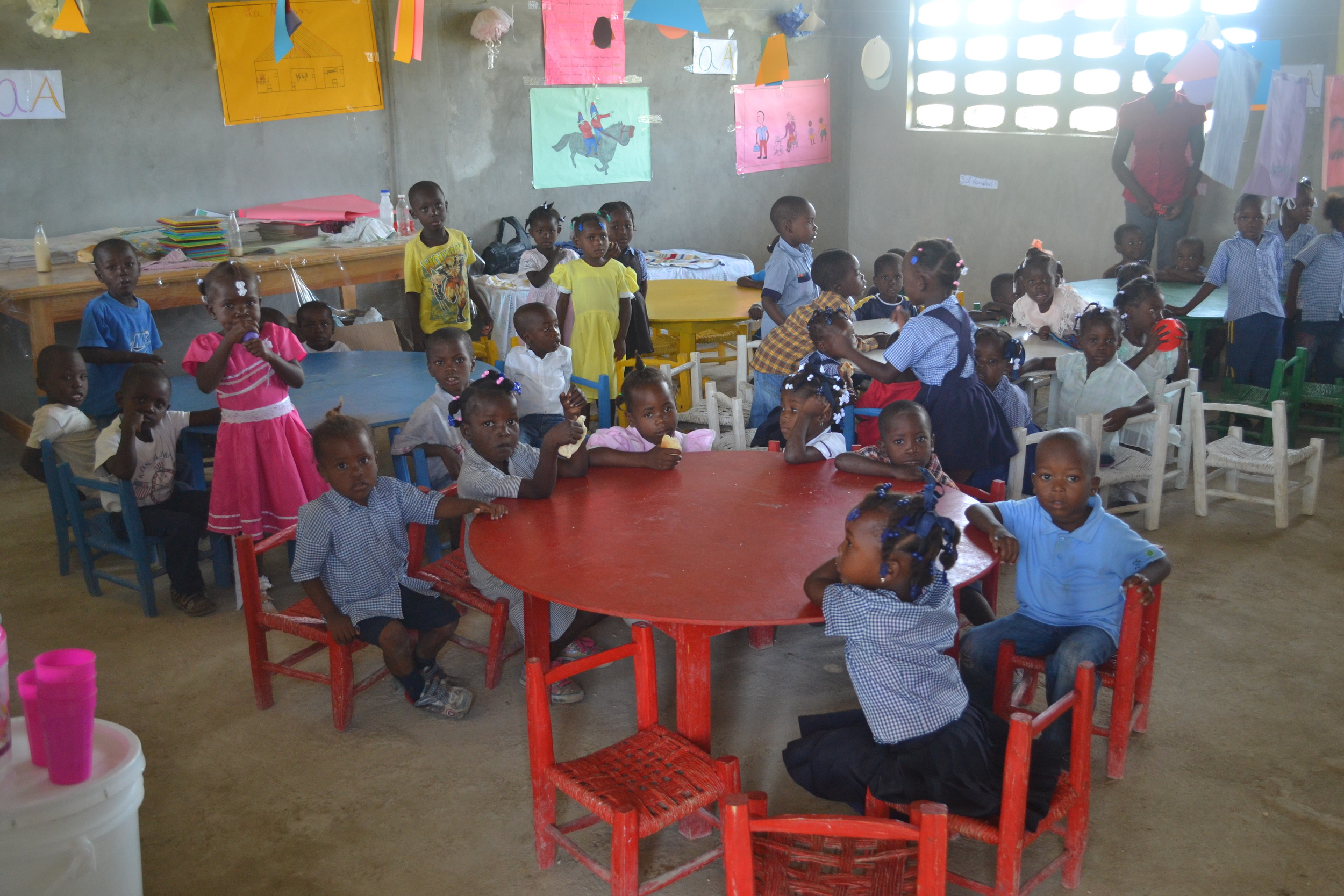
School opens with new classrooms and new library books!

School’s Open.  The school begins its third year with enrollment at 140 students in Pre-K through 5th grades. 

New Classrooms. Two more classrooms have been built this summer, funded by the $25,000 construction grant from Presbyterian Women’s birthday offering.  We are closer to our goal of having a separate classroom for each grade.

New Library. During August, members of North Decatur Presbyterian Church bought 120+ books written in Haitian Creole.  Ranging from pre-K to 4th grade reading levels, these books will supplement the 2 workbooks (one for math and one for writing) currently in use.  These books will enrich learning and start a school library.


Listing, listening, learning

A delegation travels to the EcoVillages next week to listen and learn. On Wednesday 13 April four representatives from the Atlanta Church Group arrive in Haiti. They will meet with the leaders of MPP to set goals for the upcoming period. They will see the school and meet with the school director and absorb the joy of children learning. 

Follow our News blog to see updated photos and posts as they travel. Hold the hopes of the community in your hearts as they seek ways to change the futures for so many. 

TASTE OF THE CARIBBEAN – MARCH 5, 7 TO 10PM

Please Join Us!

You are invited to TASTE OF THE CARIBBEAN:  A Celebration of the Haitian Eco Villages School on Saturday, March 5, 7 to 10pm at Decatur Art House.    All are welcome who have a heart for service and education. You can support our Haitian brothers and sisters striving for self-sufficiency, the flourishing of the eco-villages, and the thriving of the eco-village school - and have a little fun too!  Please register by March 1 at https://www.eventbrite.com/e/taste-of-the-caribbean-a-fundraiser-for-the-haitian-eco-villages-school-tickets-21134983304

What’s Up with Those Goats?

December 12, 2015 –

Now in its second year, the Holiday Gift Program is off to a great start.  North Decatur Presbyterian Church sold 5 goats 2 Seed kits and 3 bags of seeds at their Alternative Gift Mart last weekend.  Emory Presbyterian and Good Shepherd Presbyterian will be offering goats and seeds for sale each of the next 2 Sundays.

Last year’s donations provided 20 goats to the villages in the Spring of 2015.  There are now 47 goats in the program due to successful breeding.  It is estimated that once the herd gets to about 200 goats, the program will provide needed cash for the school and sustain itself.

First discussed during our trip in October 2014, it was suggested that the parents could start a livestock program to benefit the school.  The “revolving model” for this program starts with the recipient of a pregnant goat. The first offspring goes to the school and the 2nd offspring to a community member not in an eco-village, and then they get to keep the future offspring.  

So last year at Christmas time, we created the Holiday Gift Giving Program where givers can purchase an animal or seeds to benefit the school and the donor gets a card to give as a gift.  This model has been a successful holiday tradition to benefit third world people and made popular through organizations like Heifer Int’l.

When you travel through rural Haiti, you’ll see goats all along the side of the road usually tied to a tree or a cactus.  The people raise goats for their meat and many of the meals we were served during our visit in Haiti featured goat meat.  Raising goats for breeding and later sale is one way that parents are able to contribute to the funding of the school’s operations.

MPP encourages collective care of animals in each village.  So whatever animals we end up funding, they will be equitably distributed throughout the villages.  

To purchase a goat or bag of seed to benefit the Ecovillages people, see Becky Evans @ North Decatur PC, Kathyrn Hornsby @ Emory PC, or Ginger Stapley @ Good Shepherd.

- Article submitted by C. Calia

Holiday Livestock and Seed Gift Program

IMG_0781.JPG


Give a Goat. Help the EcoVillages families support their children's education!

What better way to make Christmas meaningful than with a gift from Seeds

of Hope?  You can be a part of a growing holiday tradition by investing in a

sustainable future for the families of the EcoVillage School in Haiti.

Instead of material items, choose to honor your friends and loved ones with

gifts that help struggling Haitian families provide for their children's

education.  Every goat or bag of seeds given by you this Christmas is an investment in

helping the EcoVillage families grow their crops and livestock, with the

proceeds going towards covering the operating costs of the school. 

2015 Goal

2 Male Goats per Village; 1 Goat per Family = 12 Male Goats and 60 Female Goats

Thank You!

Here's are examples of how your gifts will be spent. 

$1000    Dairy Cow

$ 650    Stud Male Hybrid Goat

$ 350    Male Smaller Goat

$ 120     Female Hybrid Goat

$100      Seed Kit - with tools

$ 20       Bag of Seeds

You can click the Donate button below to access the paypal site.  All donations are processed through our member church and go directly to support this program in Haiti. If you would like to make a specific donation, please email your wishes to sowseedsofhope@gmail.com.  Thanks for making wishes come true!

Are You Overwhelmed Yet?

Our group left the MPP compound this morning, said our good-byes and headed back to Port au Prince.  As we compare notes on all the meetings of yesterday, it's pretty clear that all the leaders at MPP and the Ecovillages are on the same page.  We've seen much progress and discussed plans for ways that the children can get fed and the teachers to get paid.  At the same time, it's apparent it's going to take a while to get there.  Where's all the money going to come from to build more classrooms and fund operations until the school is self-sufficient?  It's too overwhelming to think about that and so I revert to thinking about one step at a time.

Along the road back to the city, there is an endless stream of humanity.  A few people travel in cars, some on motorcycle and the majority are walking.  They walk to get to market carrying what they can to sell.  Or perhaps they're returning from market with a few items they've purchased. There is dust everywhere kicked up from the dirty roads.  Congestion on the road is so bad a times that it's a miracle that more people are not run over.  At the same time, we observe that they are well groomed and wearing shoes.  We don't see any evidence of starvation.  It's a tough life and it's hard to see how it could ever improve.  It's overwhelming.

After our return to Port au Prince, we go out for a "fast food" lunch.  I had brown rice, chicken, vegetables, bottled water and a beer.  It cost $6 and the food was tasty.  We had planned to be tourists for the day but learned that there were demonstrations on the route to the place we wished to visit.  The gatherings are in response to the recent elections and we have been warned to stay clear in case things get out of hand.

Instead of touring, we gladly go to the home of Cindy Corell who is our mission co-worker in Haiti.  The house is lovely and comfortable.  This little oasis is a welcome break from the chaos of the streets on the other side of the wall that surrounds the house.  I can't help but think of all those people we passed on the road that will not get a break from the difficulties of their daily existence. 

Somehow though, I don't feel depressed or discouraged.  I think about all the wonderful people I've met these past few days.  The people of the village, the people at MPP and our PCUSA friends that live and work in this country.  Memories of the smiling children at the school make me smile.  The friendliness of our interpreter Marc and our driver Bernado is in stark contrast with our perception of the hardship of this life.  The people here are respectful, grateful and hopeful.  When I think about that, it can be rather overwhelming.

submitted by C. Calia

DSC_1333.JPG


Answering the Key Questions

From the outset, the intriguing part of this development project is that it's run by the local people.  They designed the school, hired the teachers, and engaged the community.  It's not just a place to park their kids for five hours a day.  They have a vision to make this a model of a great primary school that is self-sustaining and run by Haitians.

Over the past two days, we heard the story several times that the people of the Ecovillages lost everything in the earthquake and they came to the Central Plateau to start over.  They have little.  We can help by raising the funds to construct the building but what will happen when we're gone?  How will they afford to pay for continuing operations?

To answer that key question, we started by asking the executive board of MPP about their long range vision for sustainability.  They have clearly considered this issue and have discussed solutions.  The first step is to develop the agriculture on the school property.  We saw the beans that have been planted, the peanuts that have been harvested and a tire garden being built.  Once the plantation (which is what they call the fields around the school) is developed, it should produce enough food to feed the school children.  In Haiti, the biggest meal of the day is lunch and these children will be well fed with nutritious food grown by their parents.  They will grow up knowing where the food comes from; and importantly, the school will not have to use money to buy food from the outside.  This is ambitious and will take time but could be a "game changer" when it's completed.

Even with a fully developed plantation, however, how will the teachers get paid and the school materials get purchased?  The answer may be goats and crafts.  A goat breeding program was started last year with funds that we provided from our donors.  In all, 20 goats were purchased and now there are 47 goats.  The goats are not kept at the school because there's no pen.  The goats are kept by the families in the villages with the understanding that the first offspring goes to the school and the second goes to another family.  With further purchases and breeding, we hope to get goats to allthe families that have children in the schoolwhen there are enough goats, some can be sold to provide income.

Another idea that was discussed was using the skills of the parents to start a local craft industry.  For example, they have identified 8 women in the Ecovillages that know how to sew.  If we can find and deliver sewing machines to these people, they can make school uniforms and other clothes to sell.  The parents can contribute a small amount of money to buy uniforms and pay tuition.

Once the school has classes through 8th grade, establishes a lunch program, and has students pass standardized tests, the school board will apply for accreditation from the government.  This may be a few years down the road but we can see that they have a vision, a plan and the energy to pull it off.  Our partnership is a critical piece of the plan.  A Partnership with one vision, clear roles and lots of exciting possibilities.

-- submitted by C. Calia

{pictured below is the view of the school from the main road.  there are over 20 acres dedicated to growing food for school lunches)

122.JPG


Indicators of Progress

We finally reached the day that we have been anticipating for months.  The visit to the school was to be the highlight of our trip and it did not disappoint.  The children were at recess when we arrived.  They immediately mobbed anyone with a camera and started posing.  DeeDee's iPad was popular because the children could see their pictures right after they were taken.

The children are all nicely dressed and look healthy.  Once back in the classrooms, we were able to visit each class, talk to the teachers and greet the students.  The children are all very nicely mannered.  School starts at 8am and lasts 5 hours.  To serve K-4th grade, they converted the storage room to a class for the 2nd grade.  One of the large classrooms has a partition down the center to make separate classrooms for 3rd and 4th grade.  The newest classroom that our group helped to build is now the Kindergarten.  The classrooms are decorated and the children have materials to work with.  The children don’t get a full lunch but they did get a snack that included bread, peanut butter and milk.

Our group spent some time with the principal of the school and the MPP representative that oversees the school's operation.  These two men work in cooperation with a parent committee that makes the decisions about the school.  We're not sure that we could call this committee a School Board, but it functions at least like a PTA.

Today, there were parents building a tire garden next to the school building.  It was explained to us several times that the parents must commit time to working at the school for the children to attend.  There is evidence that some agricultural development has occurred on the school property and we hope to hear more about that when we meet with the MPP executive committee tomorrow.

We've learned that we'll need to get the school serving through the 8th grade to receive government support.  The children will also need to demonstrate competency on standardize test.  So, while we have a way to go before the school can be accredited, we have come a long way.

-- submitted by C. Calia