The best Alternative Gift Market in town! We always enjoy and appreciate the wide selection of guests, shoppers and vendors at this event. We hope to see you virtually. Notecards are available for purchase and donations in honor of a teacher make a great gift! Click here to go directly to the Alternative Gift Market page on our website.

A Boy with a Future
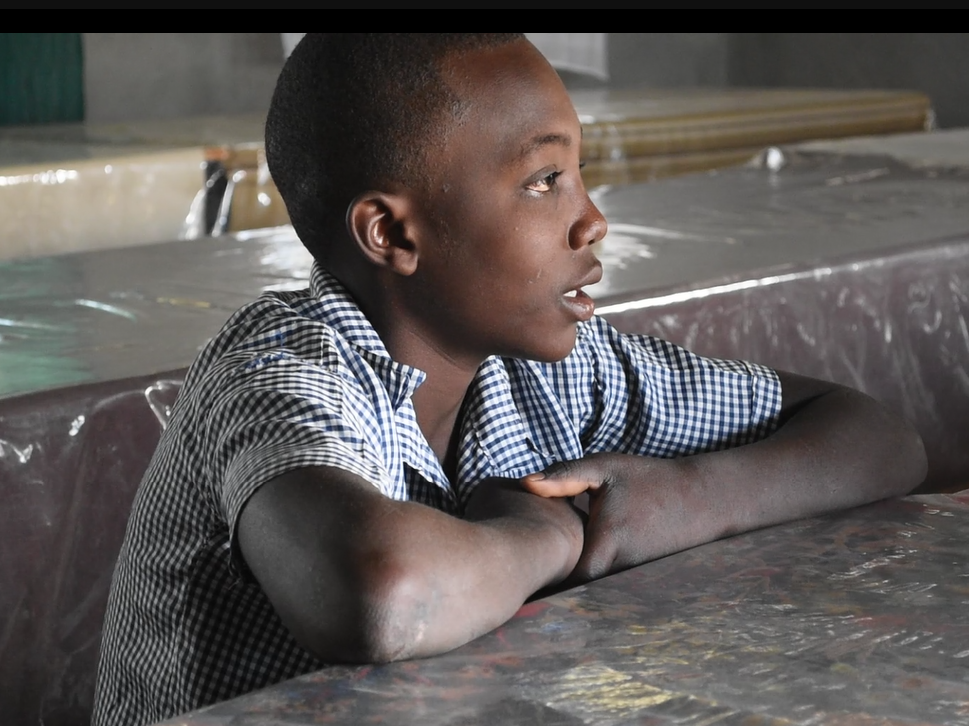
D’Jephly sits down to talk with us in April, 2019
D’Jephly Viscount was 14 years old and in the 7th grade when we interviewed him in April, 2019. Today, he is part of the 9th grade class at the Ecovillage School that will take the National Exam that will determine if he can progress to high school.
His family lives in the nearby town of Colladere. Approximately two-thirds of the students at the Ecovillage School live outside the villages. It was one of the goals of this project to provide a quality education not only for the children living in the Ecovillages but to serve the surrounding community as well.
D’Jephly started his education at the primary school near his home in Colladere. He switched to attend the Echovillage School when he was in the 3rd grade because his parents thought he would get a better education there. He has 5 brothers and 2 of them attend the 4th grade at our school.
He and his brothers must walk for one hour each way to attend school. This is common in rural Haiti where transportation services are nearly non-existent. But his parents, like many parents in Haiti and around the world, recognize the critical importance of education as a key to a better life. Many of the parents in Haiti cannot read themselves and must rely on the schools to provide instruction, books and other resources essential to education.
This stage of school is equivalent to middle school in the United States. The students receive instruction in multiple subject areas including English, Spanish, Math, French, Social Sciences, Experimental Sciences, and Kreyol. The different subjects are taught by different teachers who specialize in the various subjects. The principal at the school is also the Kreyol instructor.
D’Jephly told us his favorite subject is English. Perhaps he was simply trying to please us, but we had a small exchange in English. It is hard for these students because there is no place to use English outside the classroom.
Like most boys in Haiti, he likes to play football (soccer) and wishes there was a playground at the school for boys and girls to play games when not in class. He also told us he wished there was transportation because it’s a very long walk for him.
We pray that D’Jephly is successful in passing the 9th AF Exam in July 2021 and that he can move on to High School. That would be his best chance at a better life and the aspirations his parents have for him.

Boys at the EcoVillage School play soccer on a makeshift field with balls donated by the Partnership.
Meet Beatrice

Beatrice is 16 years old and in the 8th grade class at the EcoVillage School (aka Ecole Nationale St Jean Bapiste de Beganabe). She has attended the school all six years that it has been open. I had the opportunity to interview her during our trip to Haiti in April 2019.
She grew up in the town of Jacmel in the southern part of Haiti. She has 3 brothers. In 2010, the earthquake that devastated Haiti destroyed her home. Both of her parents died. She moved in with her aunt and continued to live in Jacmel for a while but life was difficult there in the aftermath of the earthquake.
When given the opportunity to move to the Central Plateau, she moved with her aunt’s family to the EcoVillages. There she was able to have a home, healthy food to eat and to go to school. She lost a couple of years of schooling because of the earthquake but the school in the EcoVillages has given her the opportunity to continue her education.
Beatrice told me about how much she loves her school, her teachers and her principal. She is able to have an opportunity for a better future through education because of the dedication of MPP to make the school a reality and the donations of the Americans who support their efforts.
submitted by C. Calia
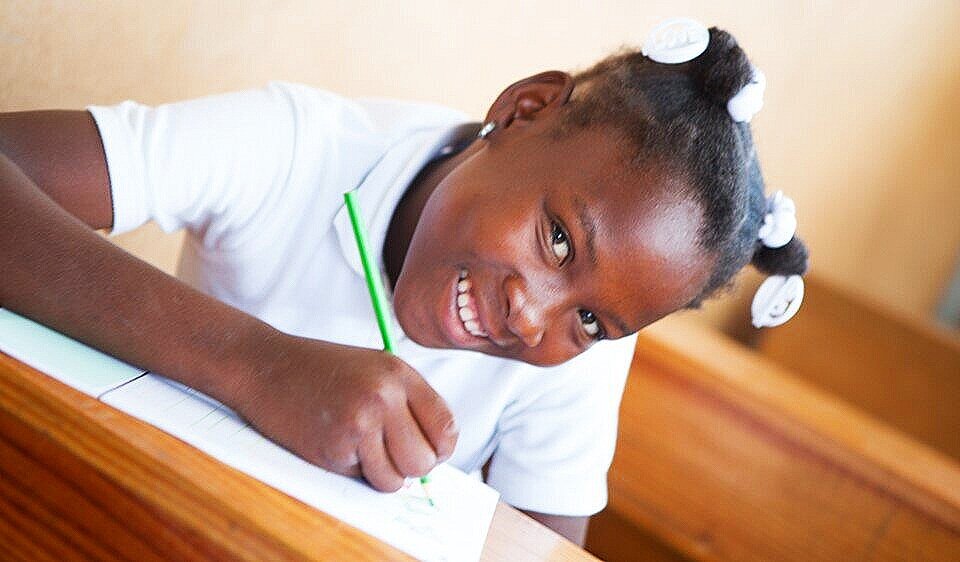
Beatrice in the 5th grade. Photo taken during our trip in April, 2017.

Beatrice in 2017 with Artwork describing herself
First Class of Ninth Graders at Haiti EcoVillage School!

This is a critical year for the 9th graders at the Haiti EcoVillage School. They must complete the required curriculum and pass the Haitian National Performance Examination. Passing the exam opens the possibilities of further education and a vision for the future. They are working hard now to meet this challenge and to surpass expectations!
As they work in their studies, the Haiti EcoVillage School Partnership is working to find funding to keep the school open. Our teachers and our students are depending on our success so they have choices for their futures.
You can help. Click here to donate so we all surpass our goals!
Hunger Relief at Just the Right Time
In the past year, Haiti has been stricken with political upheaval, economic hardship, drought and now COVID-19. We put out an appeal to help the people of the EcoVillages and you responded. Within days of our asking, we were able to send money to buy food and seeds for the villagers.
They sent us this video in response to our generous gift.
Staying Connected

Back in October, I wrote about my friend Carlos (see “My Friend Carlos”). He continues to write emails to me when he can get access to a computer. In this time when it is not possible for us to travel to Haiti, Carlos has become an important, reliable source of news about the people of the Ecovillages and the school. In a recent email, he wrote about the present situation:
“At the moment things are very complicated in the villages. The land is completely dry, deserted, with no planting because the rainy season has not yet started. During this period the villagers have no activity.
The rainy season gives them activity. They will work together in their gardens when all the villages are green and very beautiful. When the rainy season arrives (this year), I don't think they will have the means to cultivate their land since they barely manage to find food once a day.
The current situation is extremely difficult for them. I could see it in 2 villages that I visited but my father told me that it is like that in all the villages. They share food with each other when possible. I saw my family feeding the children of another neighbor and it pleases my father very much to be able to help people even if he also needs help.
We are in the mango season. Some children eat them prematurely for lunch and sometimes for the whole day. They buy food on credit more often than not and cannot pay.
Once the mayor or the delegate of the city of Hinche sent a small bit of rice for them and my father took advantage to benefit the people who live near the villages because they are also in the same starvation situation.
The school hasn't been running for more than a month or so (as all schools in Haiti are shutdown during the pandemic). I think the kids will not lose the whole school year.”

An image from 2019 after the rains have arrived.
In the United States, losing your job may mean you have to drive to a food bank to be able to feed your family. But, in Haiti, there is no safety net; just going without. They share what little they have with each other. When they contact us, they ask “how are you doing?”
submitted by C. Calia
Remembering Haiti
This time last year, we were celebrating Easter in a church in Hinche, Haiti. It was a blessing to travel to Haiti with a group of 9 Americans focused on working with Haitian partners to sustain a school in the Central Plateau. Personal bonds were forged with our Haitian friends and our traveling companions. The experience was deeply impactful and leaves us in a state where Haiti is never far from our thoughts.

Our travel delegation to Haiti in 2019
Plans to return to Haiti in 2020 have been scrapped amid the pandemic. Our friends and supporters ask us how Haiti is fairing in the midst of the pandemic. The simple answer is that the health impact is small for now. To date, Haiti has reported 58 cases of COVID-19 and 4 deaths. But the Dominican Republic has been hit hard and a new story published in the New York Times outlines the threat of laid off Haitians in the DR bringing the virus across the border.
Experts say that no country will be spared in this pandemic. Neither warm weather nor limited travel by foreigners will prevent some level of sickness and death. In a country with poor public health infrastructure and data collection, we'll probably never know how many people in Haiti contract the virus and how many die from it.
COVID-19 poses new challenges. How do you practice social distancing in a country that has no infrastructure to support a "stay at home" policy? How do you care for contagious people in a country with too few hospital beds, limited medical equipment and little capacity to produce medicines? This is different than past disasters (like the earthquake of 2010) because foreign assistance is unlikely when so-called "first world" countries are struggling to fight the pandemic and most NGOs have pulled out of the country. Haiti is left to go it alone.
This past year has been tough on the people of Haiti. A country that is no stranger to hardship, the past year has seen economic volatility, food insecurity and political unrest. There is little trust in the government. More than half of Haitians live "hand to mouth". It is unlikely that the cycle of subsistence living and dependence on foreign aid will end any time soon.
We follow the news in Haiti, we communicate with our friends who live there and we continue to work with our partners to seek ways to help. They are a resilient people who are no stranger to disasters both natural and man-made.

Some of the over 300 children getting an education at the school we helped to build.
In midst of all this, a truth emerges that families survive, children grow, and families continue to hope for a brighter future for their children. That is why education continues to be a priority. Education is still the single biggest factor in lifting people out of material poverty.

Some of the parents we met with during our visit in 2019.
Our mission to help the people of the Central Plateau has seen many successes. Construction of 9 classrooms and a refectory are complete. For 5 years, children who might have otherwise been denied education have been taught by dedicated, professional teachers. The school has been recognized for its quality and has been nationalized. Our support and their determination has brought these successes. But current hardships put the future in doubt.
Our unwavering plan is for a self-sustaining school that is run by Haitians and supported by Haitians. Turmoil in the government has slowed progress toward public funding for the school. Our agricultural initiatives have been thwarted by drought, economic recession and other complications. Without a trip to visit with our partners, our planning has stalled. For now, we continue to support the school financially and pray that we will be able to resume our work soon.
As we sang together in Creole last Easter, “Nap marche -Na Lee-mu-yeah Bon Dye-a.” which roughly translates to "We are marching in the light of God.".
Let’s keep marching with our partners, virtually for the present, through the COVID-19 Pandemic and through prolonged crisis in governance in Haiti.
Thank you for your creative thoughts and solidarity.
Contributed by Chris Calia & Bailey Green
P.S. Sunday, April 26, 2020 is the date we originally planned to hold our annual fundraiser at the Clarkston Community Center. This event is on hold indefinitely but the need continues. Please consider a donation through our website or your local church to keep these children in school.
A Prayer for Justice

In Genesis 1:31 God saw all that he had made, and declared it was very good. The remainder of the Bible describes how man messed it up. Which brings me to the subject of Haiti.
Haiti is a mess. We knew it was a mess when we started our mission work there but, right now, it is particularly bad. As we followed the news over the last year, we know that there have been several periods of protests against the current government. The protesters claim that the government is corrupt and has misappropriated billions of dollars intended to rebuild the country's infrastructure and economy. As a result, there is price inflation, fuel shortages and starvation. The food situation is exacerbated by an extended dry period that has thwarted food production.
The political unrest in Haiti is part of phenomenon known as the Global Protest Wave of 2019 which played out in many countries around the world including Bolivia, Chile, Columbia, Libya, Lebanon, Iraq, Iran, and Hong Kong. In each case, the people are mistreated by their own government and find their only remedy is to pour out into the streets in protest.
So, today, we pray for resolution to the political situation in Haiti along with all those troubled places where injustice is playing out.
The situation for the people of the Ecovillages has grown worse as the country has fallen into disarray. We pray that the Spring rains will be plentiful this year and they have a good crop. In the meantime, food, money and jobs are in short supply.
We learned that the school we helped to build was shut down for a few weeks in the Fall along with most institutions in the country during the peak of the protests. School is back in session now and they are making up for lost days. The school building is now complete and the enrollment is around 300 students in grades K-8. The funds we contribute pay for the teachers and other staff. We continue to work with our partner, MPP, to develop a mechanism for self-funding even as it is evident that support from the government is unlikely in the near future. Next year, we expect some of the students to progress to the 9th grade and take the national exam which is the gateway to high school.
In the mist of all the dismal news, the truth remains that hope for the next generation lies in education. Even with all the struggle, the school is a top priority for the parents.
So, we pray for the villagers, the school staff, the parents and the students to thrive in the shadow of adversity and to succeed where success seems so rare.
A lot has transpired since our last trip to Haiti in April of last year. We read the news and get occasional emails about the situation. But our experience with the Ecovillage school mission is that we don't truly know what's happening on the ground without traveling there. So, in March of this year, we plan to send a delegation to Haiti to meet with our friends, find out what's going on and assist them with a path forward. We pray for safe travel and success in our quest for answers. The people of Haiti put their hope in our Savior Jesus Christ. They are our Christian brothers and sisters. We pray and worship together in solidarity. This mission reminds us to praise God for our many blessings and for the opportunity to help others in need.
May God continue to bless the United States and continue to use those blessings to help others.
Amen
(a prayer of intercession at Good Shepherd Presbyterian Church 1/26/2020)
“We are living a disaster.”

Perhaps you remember Chavannes, founder of the EcoVillages in rural Haiti, as the grandfatherly gentleman who visited Atlanta last year. He thanked us for building the EcoVillage School and asked us to help finish the project.
Today, he is more Jeremiah than grandpa, prophetically calling on the President and his wealthy supporters to mend their ways. He is helping lead the nationwide, peaceful rebellion against corruption in government and oppression of Haiti’s poor.
Haiti is in crisis. What began months ago as occasional demonstrations has escalated into a full-fledged effort to shut down the country until the government falls. Schools, government functions, ports and banks are closed. President Moise refuses to resign, with the support of the U.S. government. (To learn more about the backstory of the people’s revolt read “ ’There Is No Hope’: Crisis Pushes Haiti to Brink of Collapse,” New York Times, October 21 https://www.nytimes.com/2019/10/20/world/americas/Haiti-crisis-violence.html )
The unrest, which in the first months was concentrated in the capitol Port-au-Prince, has now reached our friends in the Central Plateau.
Pressure and threats to join the nationwide shutdown led to the closing of the EcoVillage School in October. A few days ago, Director Ramain and the parents courageously reopened the school, watching to see if it will be safe. Almost all of the other schools in the country are closed.
Our friends in the EcoVillages are fortunate to have their own food. They can subsist, but many others are in trouble. 60% of Haiti’s food comes from imports. NGOs report that as many as 3.5 million people need emergency food assistance now. (To learn more about the current food crisis read, NGOs warn about deterioration of food security in Haiti,” ReliefWeb, November 21 https://reliefweb.int/report/haiti/ngos-warn-about-deterioration-food-security-haiti-more-35-million-people-need-emergency )
The Atlanta EcoVillage School Partnership will keep you informed about events. Haiti was in the news on January 12, the 10th anniversary of the greatest natural disaster in the history of the Western Hemisphere, in which as many as 250,000 people died. Please keep the Haitian people in your prayers.
Photo Book is a Hit

Sharing the Photo Book at the School
During our last visit to the Ecovillage school, we had fun sharing a photo book that Carolyn created about the children of the Ecovillages. It was exciting to share this beautiful book with the children and they were excited to see themselves in the pages.
After school, we walked with some of the children back to their homes in Village 1. Shortly after our arrival in the village, I noticed the picture book I’d been sharing had gone missing from where I put it down. I started walking around trying to find it and came upon two boys who had run home to show the book to their father!
I grabbed my camera and took a photo of the them proudly sharing the book to their dad. When he realized that I was taking the photo, he asked that I wait while he mysteriously disappeared into his house. After a couple of minutes, he returned wearing a clean shirt. He wanted a proper photo of him with his children.
As always, the Haitian people we meet take great pride in their appearance. Despite their meager means, they are always clean and well-groomed.
recollection by J. Calia

Children showing the photo book to their father.

Posing for the camera.
My Friend Carlos
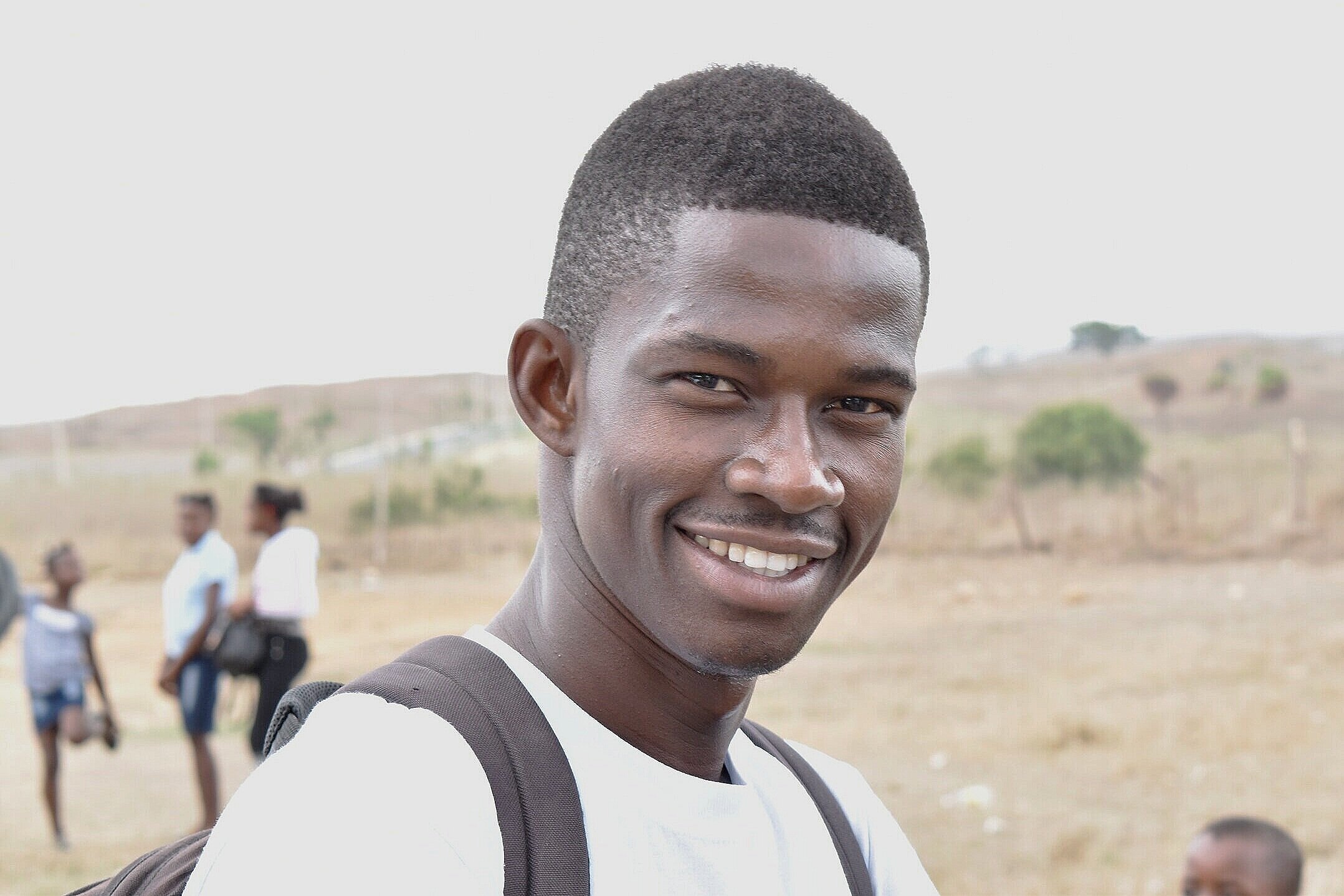
Carlos is studying to be a medical doctor in Haiti. He has completed his academic studies and is now doing his intern rotations. This is what gives me hope for Haiti. That a young man would overcome huge obstacles to pursue higher education and become a doctor is truly inspiring.
It is particularly remarkable in a country where half the children don’t attend school of any kind and few graduate from high school. Reaching this achievement is a testament to his hard work and to the dedication of his family to support him and provide opportunity.
His parents live in the Ecovillages. He is the oldest of 6 children. His father is a truck driver and a farmer. His mother works at the Ecovillage school that we helped to build. All of the children in the family attend, or have attended school, but there is only enough money to send one child to university. Even that is a struggle
Carlos aspires to specialize in public health, infectiology or hospital administration. He dreams of creating an organization to do mobile clinics every 3 to 6 months in areas where people do not have access to health care. He also loves to teach and would like to open a permanent clinic someday where he can promote healthy practices in children.
His family had a lot of material loss after the earthquake in 2010. Moving to the Ecovillages gave them a fresh start.
I have been corresponding regularly with Carlos. He keeps us up to date with news from the Ecovillages and of the school. He says our email exchanges are a good opportunity to expand his English vocabulary.
In 2011, he was baptized in a church in the city of Lascahobas. One of his favorite Bible verses is “In everything I did, I showed you that by this kind of hard work we must help the weak, remembering the words the LORD Jesus himself said: 'It is more blessed to give than to receive.' " - Acts 20:35 35
- Submitted by C. Calia

Carlos with his parents

Visiting his family in Village 4
Books for our children
Our annual fall book drive continues. Our three partner churches will have books available, and if you can’t make it to church, click the donate button and send your support of books for the children.
Our bookseller partner has been so helpful in finding books for us in Kreyol, English and/or French, as requested by the school director. He has tirelessly worked with our team to deliver the books at prices we can afford. We are most grateful. Meet John.
