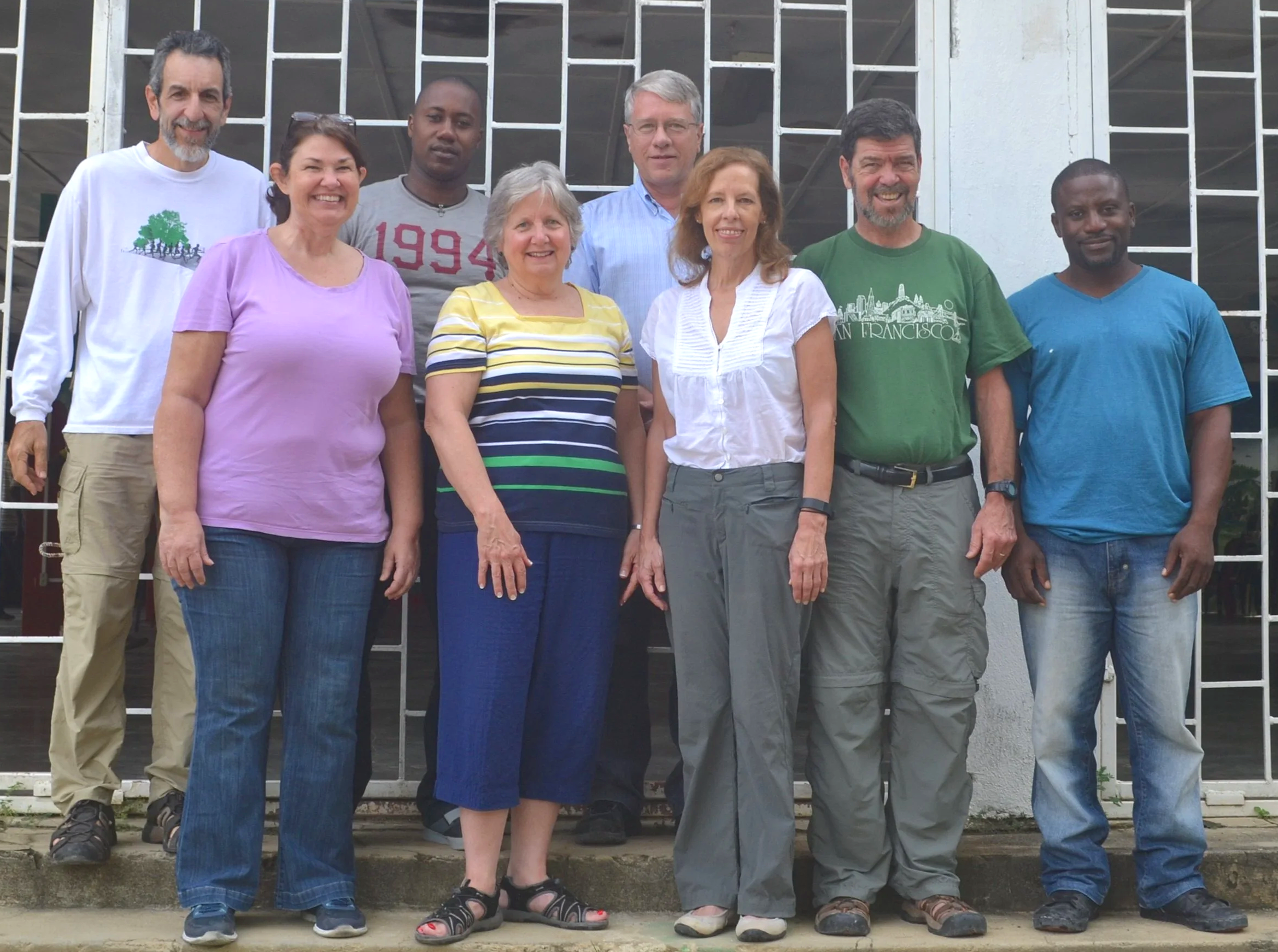
My travel group from Atlanta to Haiti in 2015. I am front row, second from the left.
“Because of You, They Come to School Ready”
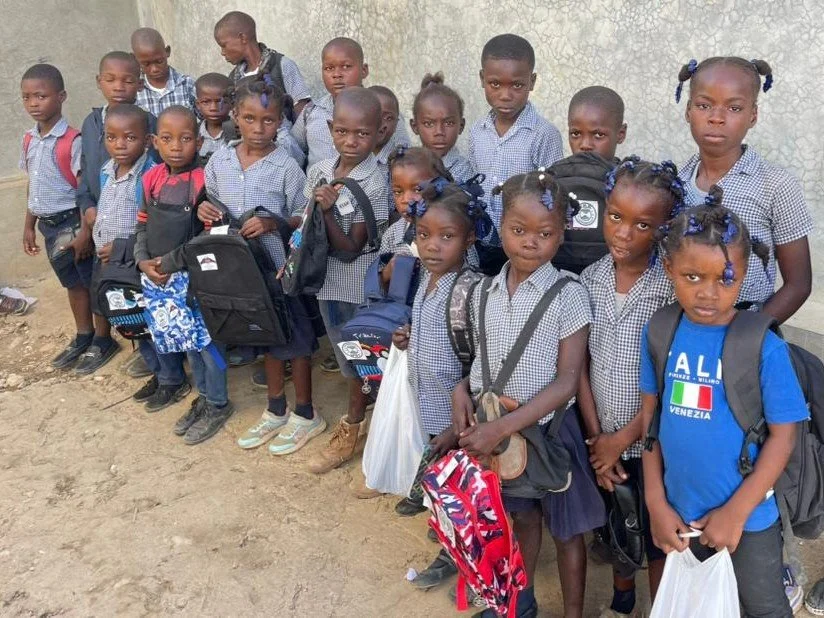
"Whew! No more sore feet. Kids at the EcoVillage school get needed shoes and supplies.
April, 2026
At our last fundraising event in November, we shared a simple but urgent need for the children of the Haiti EcoVillage School. Many students at the school lacked basic supplies—shoes for the long walk and backpacks to carry their books. Our interpreter, Wesly Saintilus (who studies in the U.S.), contacted his sister in Haiti who was able to provide a detailed list of students in need. Attendees at the fundraiser were provided with the list and responded with generous gifts that enable us to meet the need.
Here is an account of how we were able to make this happen for the children.
From the Field: A Message from Judith Saintilus
My name is Judith Saintilus, and I live near Hinche, about five miles from the Haiti EcoVillage School. When my brother Wesly spoke to me about the need for school supplies, I was grateful for the opportunity to help.
We began by visiting the school and meeting with the principal, Ramain Exil. We explained that we had come on behalf of Atlanta supporters who wanted to help students who lacked shoes, backpacks or uniforms. We learned that many of the new students were from displaced families that had to flee their homes in the south of Haiti due to gang activity. The principal welcomed us and gave us permission to visit the classrooms and observe the students.
Over the next visit, we went classroom by classroom. We looked carefully to identify the children who did not have backpacks or uniforms, those without proper shoes, and even some whose uniforms were worn. We recorded each student’s name, age, and shoe size. The need was real and wide-ranging—from young children in early grades to older students working hard to continue their education.
After completing our assessment, we sent the information to Wesly. Soon after, funds were made available through the partnership between the Wesly Wonderful Foundation and the Haiti EcoVillage School Partnership. With these funds, I traveled to Cap-Haïtien and nearby markets to purchase shoes, backpacks, and uniforms.
Once everything was ready, we coordinated with the principal to schedule distribution. Over two days, we gathered the students and distributed the items based on each child’s need. For those who could not attend, we left the remaining supplies with the school so they would not be left out.
This effort meant more than simply giving materials. For many students, having shoes makes the long walk to school possible. A backpack allows them to carry their books with dignity. A uniform helps them feel included and ready to learn.
I am thankful to have been part of this work, and I am especially grateful to the supporters who made it possible. Your generosity reached each child in a very real way.
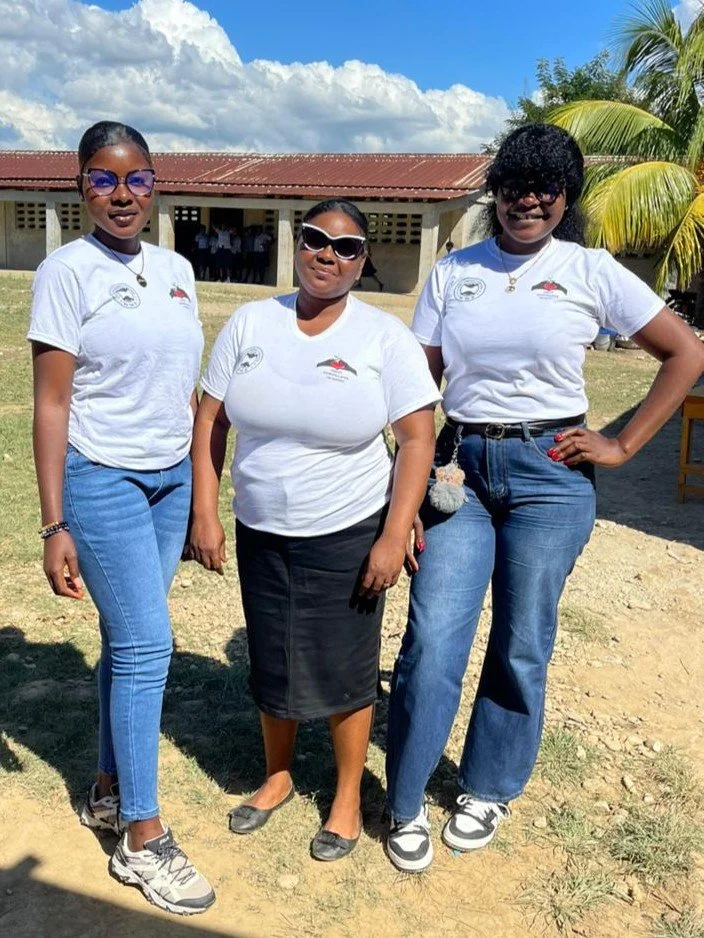
Pictured are the Team in Haiti that was able to procure the supplies and distribute to the children.
(Left to right) Bedniflore Saintilus, Judith Saintilus, Andaline Saintilus
Our Teachers are our Heroes
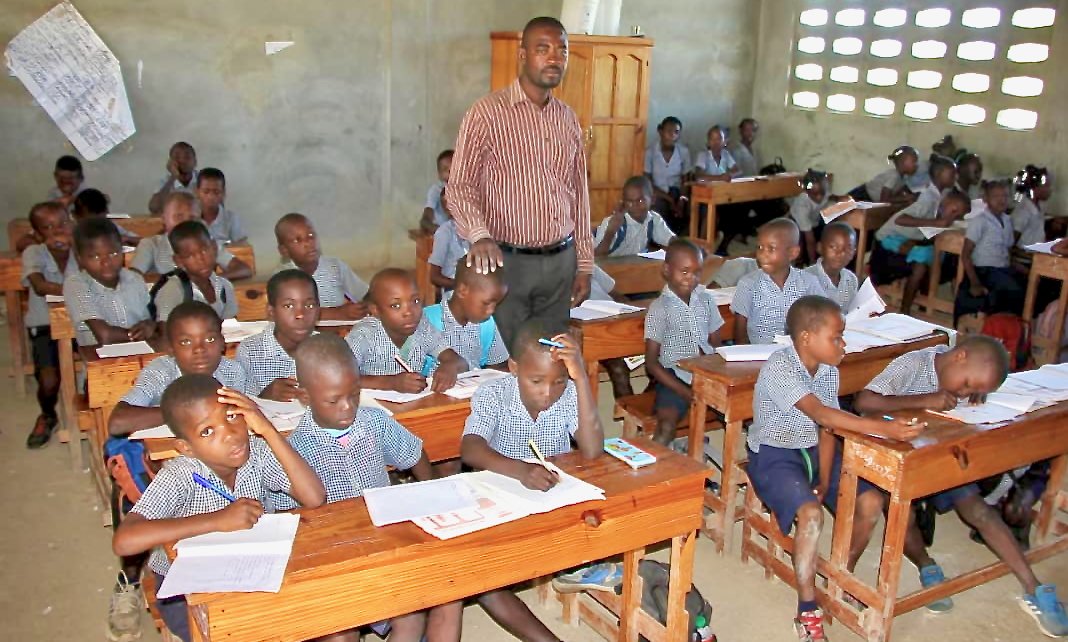
Teachers are the backbone of the EcoVillage school. They serve not only as educators but also as mentors and role models, shaping the future of the children they teach. All are experienced in the classroom, with most having several years teaching in the EcoVillage School. From year-to-year turnover is almost nonexistent. This is crucial since educational materials are in short supply while classrooms are bursting at the seams with the arrival of refugee children whose families have escaped the violence of the big cities. Chalk and blackboard are their chief teaching aids. These are challenging times to be a teacher at the school.
You would expect all of this to weigh on student performance. Not so. The students have continued to excel in their studies. Over 82% of last year’s students progressed to the next grade level. Results of the national gateway exams were outstanding, with a high percentage of our 9th graders passing, allowing them to advance to high school. This success is a direct result of our dedicated teachers, who are committed to maintaining high educational standards despite limited resources. These accomplishments have helped the EcoVillage School maintain its national accreditation, which is particularly significant in a country where most schools have been forced to close due to lack of funding and support.
Now for some irony. The Haitian government is virtually nonexistent -- no president, no legislature -- but the Ministry of Education continues its role by adding requirements to the curriculum. It has mandated the addition of three new subjects: technology, the arts and physical fitness. All good things. But the Ministry, which is required by the Haitian Constitution to pay educators like the ones at the EcoVillage School, offers not one cent. Mandates without financial support for strapped schools to meet them simply adds more stresses. Oh, well. At least it’s worth knowing that employees at the Ministry probably aren’t being paid, either.
In addition to these external factors adding pressure to teachers, inflation and the devaluation of the Haitian currency has eaten into the spending power of teachers’ pay. Plus, transportation is more difficult and fraught with the sketchy availability of gas and the spread of gang violence. Most EcoVillage teachers live at least 5 miles away. Because of these concerns, the Atlanta Partnership has committed to increasing the salaries of the teachers. It’s only fair. Teacher salaries have averaged $2000-2200…per year.
Since teacher salaries are the lion’s share of the school budget, even a modest increase puts additional pressure on our fundraising. This makes your support ever more critical. Your contributions are shaping a brighter future for the children of Haiti. Thank you.
Henri Survived. What's next?
“…Even if you want to escape, you have to go through thorny paths where you’ll get pricked. You can't escape with anything; if they see you escaping with something, they will kill you or pressure you. When you flee your home and if you want to return, you have to pay the gangs. The situation is really difficult; nothing can function…”
Henri Louvensky knows thorny paths. His life descended into chaos and violence as gangs took control of his once “normal” neighborhood in Port-au-Prince, Haiti. Henri and his family escaped. Their journey was a difficult one. With danger lurking around every corner, they left their home, their lives and the streets that had become war zones. They risked everything to find safety.
“…We left our home without taking anything. We have no money to live. It's our uncle who had some… If not for him, we…would just be sitting, not doing anything.”
Henri’s uncle took them in and enrolled Henry in the 9th grade at the Haiti EcoVillage School. They have found safety living in EcoVillage 3, but the challenges are far from over. “The insecurity really overwhelmed me. The sound of gunfire had a big impact on my ears..”
Henri’s story is a simple yet powerful call for peace and stability. He dreams of a future where children like him can live without fear, where families can stay together, and where schools can provide more than just safety—but also hope, learning, and opportunity.
The EcoVillage School provides a lifeline for children like Henri. Every dollar donated goes to the school: to keep the doors open, to pay the teachers, to buy books and supplies, and to offer these young minds a safe place to grow and learn.
Henri reminds us our support is critical. Join us in our mission to help Henri and others like him find a path forward amid the challenges they face daily. Your generosity makes a lasting impact.
Meeting Medical Needs at the Haiti EcoVillage School

Young children are active, curious and often susceptible to minor injuries or sudden illnesses. These health concerns are an unavoidable part of daily life, especially in a school setting. Being able to respond quickly and effectively is vital.
The Haiti EcoVillage School is in a rural area and access to medical care is quite limited or delayed. Children often skin a knee or become ill during the day. Without any medical supplies available, the school principal would need to take students to the hospital in Hinche. Director Ramain recognized a well-stocked medical kit on site would allow the school to address these issues promptly, providing comfort and immediate care to students, addressing both their physical and emotional well-being.
Ramain requested contents of the kit to reflect the diverse needs of the school community. Items like bandages, antiseptics, and pain relief medications are essential for treating everyday cuts, bruises, and minor illnesses. Meanwhile, supplies like sanitary napkins and diapers ensure that all students, regardless of age or gender, can maintain their dignity and comfort throughout the school day.
There are no funds to purchase these medical supplies within the school budget. One of our supporters provided a designated gift so that Director Ramain can purchase these needed supplies. This gift is consistent with our core value to provide what the Haitian people need to help themselves.
By maintaining a comprehensive medical kit, Haiti EcoVillage School shows a commitment to creating a safe and nurturing environment. In a place where external challenges can feel overwhelming, the ability to provide basic healthcare supplies is a small but powerful step toward building a stronger, more resilient community.
Haiti EcoVillage School, Fall 2024

The Haiti EcoVillage School stands as a beacon of hope in a country where daily life is defined by uncertainty and hardship. While much of the country struggles with violence, hunger, and the absence of effective governance, the school provides a sanctuary of safety, learning, and community.
Attendance has surged, and the quality of education remains high. Our committed teachers continue to show up every day because they know their work is vital for the future of Haiti. In spite of the collapse of the government, the school’s resilience is evident.
The Haiti EcoVillage School Partnership is dedicated to raising the funds necessary to keep this beacon shining. Without our support, the school would simply cease to operate. 400+ children would be left without education, safety, or a daily meal — the only solid meal for many students.
Eleven years ago, when this partnership was founded, we envisioned a self-sustaining school, eventually funded by the Haitian government. However, the reality in Haiti has changed, requiring a renewed commitment from us. We choose to continue our mission, embracing the values of faith, courage, resilience, and commitment.
Social events, fundraising efforts, and steadfast support from local churches and donors continue to ensure that the Haiti EcoVillage School remains a thriving oasis of learning and stability in a sea of chaos.
In a place where a human dignity is challenged every day, we provide the resources to keep this essential institution going. Our students, teachers and families deserve nothing less.
Thank you for helping us keep hope alive.
Resilience in Fearful Times

How do you cope when your circumstances become overwhelming? How do the children and families in the EcoVillages find courage to continue? It’s hard for us to comprehend how they are dealing with the forces against them as Haiti struggles with political, economic, and environmental realities that seriously challenge every aspect of daily life.
For the EcoVillage community, political instability means living in uncertainty and fear. While our school provides a sense of safety and continuity for the children, the broader environment remains oppressive. Government support for essential services, such as police, education and healthcare are either underfunded or unavailable.
Inflation is soaring, and the value of the national currency has been steadily declining. These economic difficulties result in high prices for basic needs, including food, fuel, and school supplies.
Many families in the EcoVillages struggle to afford daily necessities. Despite these hardships, the EcoVillage School has continued to operate thanks to the unwavering commitment of our teachers, partners, and supporters. The community faces the challenge of sustaining these efforts amidst ongoing economic difficulties.
Deforestation, soil erosion, and water scarcity are rampant due to unsustainable farming practices, natural disasters, and lack of environmental regulations. A recent report highlighted how climate change and environmental damage continue to threaten the country's fragile ecosystem, making it harder for communities to thrive.
In the EcoVillages, water scarcity impacts both daily living and agricultural activities, which the families depend on for their livelihood. Unpredictable weather patterns, such as droughts and heavy rains, also threaten crops, further straining the community's food security and the ability of the people to earn income.
UNICEF reports over 900 schools have closed with more than 150,000 students being displaced. Families are fleeing the violence in search of safety and hope.
Our EcoVillage School and community remain determined and resilient. The people have adapted to harsh realities with incredible courage. The school itself is a beacon of hope, offering stability, education, and a sense of normalcy for the children. Our school continues to accept children who have escaped the violence—our benches are overflowing. With the support of donors, partners, and organizations like MPP, the community continues to find ways to support its members, nurture its children, and look towards a brighter future. Their resilience inspires us.
Students Succeed at the EcoVillage School
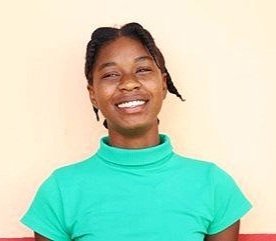
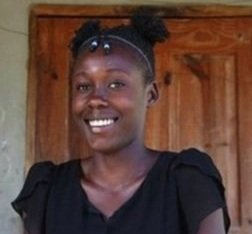
Jessica Estin (left) and Shmiderlie Étienne (right) are two of our 9th graders who passed the National Proficiency Exam this year. Seventeen 9th graders took the exam; 14 received scores necessary to graduate from the fundamental school and continue to the next level of education in Haiti. Their successes demonstrate1` the quality of education at the Ecovillage School.
Jessica was the top scorer on the exam. She is the oldest child in her family and she lives in Ecovillage 1. In an interview this summer, Jessica said that she performed very well on all of the exam but the physical science was a little bit difficult for her. Jessica wishes to attend high school at St. Louis Joseph Janvier College in the city of Hinche. Jessica is grateful to the Atlanta Partnership for how they support the school. She acknowledged how the Partnership: has provided students with school materials to allow them to work better; has paid teachers, and has helped the most vulnerable by providing uniforms and shoes so they could attend. She says, “May God continue to protect your life, your family and always put money in your hand to continue supporting the school”.
Shmiderlie is another student who passed the official exams from the school. She lives in the nearby town of Beganabe with her mother, Eveline and her father, Kenson. Shmiderlie plans to continue her studies at Lycee Dumarsais Estimé (a college prep high school) in Hinche. Shmiderlie gives the Atlanta Group a big thank you for supporting the school and the students, and she says, “may the almighty God always bless them and their entire family”.
With the political and economic turmoil in Haiti at this time, the progress of these students in their education is only possible because of the financial support of the Haiti Ecovillage School Partnership.
Our Teachers: Champions of Hope for Haiti
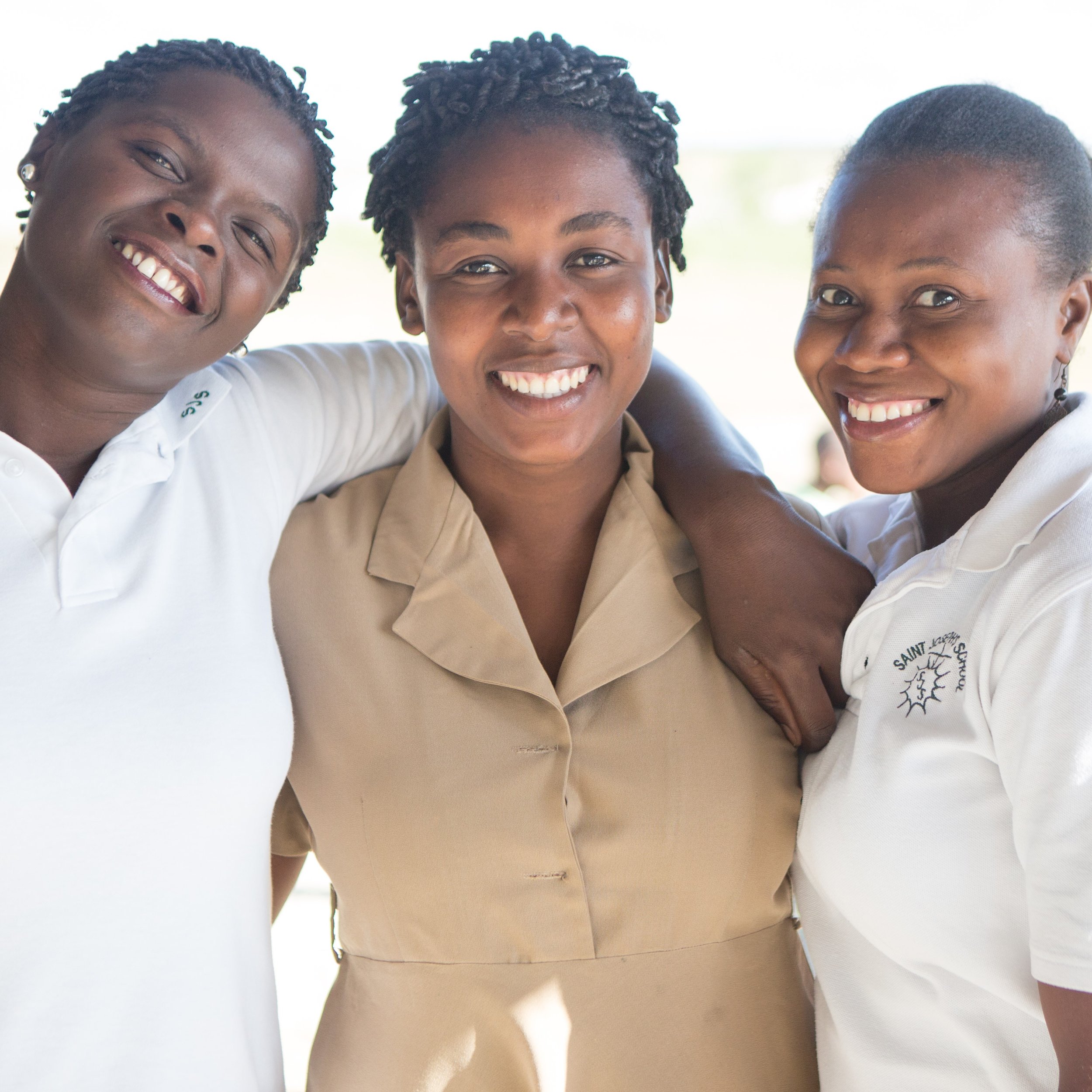
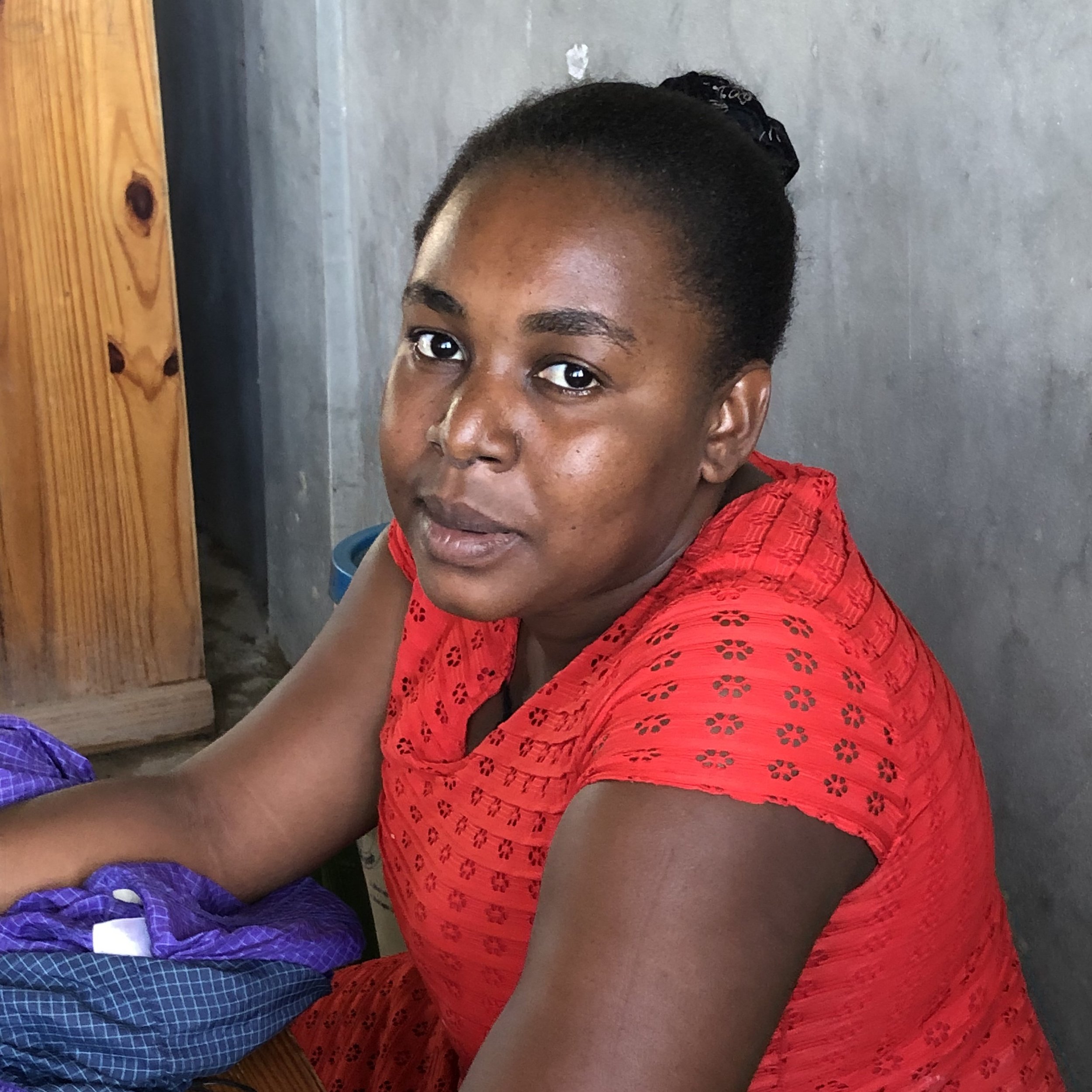


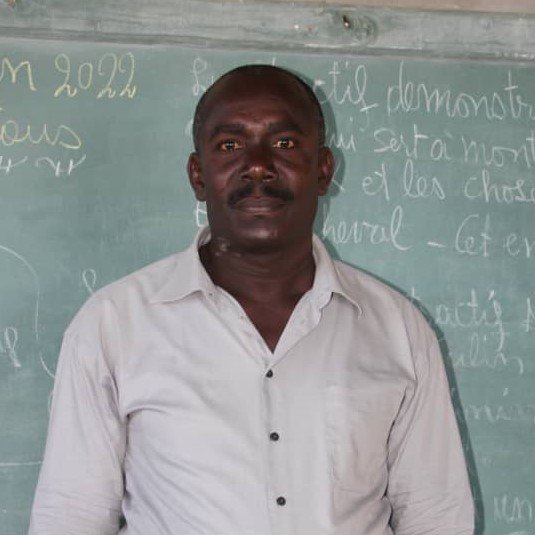


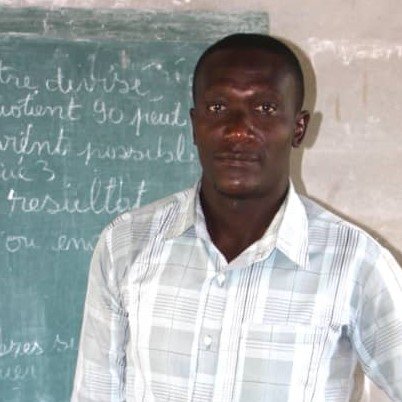

Our teachers are our heroes—they persevere under great hardships to show up each day to teach our children. Recently our communication liaison Guerda met with the teachers who shared information about their lives and their experiences today in Haiti.
Our teachers travel to the school from various parts of Haiti but most live in the nearby city of Hinche. Some have motorcycles to ride the five miles to school, but many must hire a ride for their commute. Fuel is very expensive (about $12/gallon now) so transportation is a huge personal expense for them.
Our teachers struggle to make ends meet and provide for their families. Inflation is rampant. The Haitian gourd has fallen to 1/3 of its value since we opened the school in 2014. The teachers are very grateful to our Haiti EcoVillage Partnership that provides their salaries (most teachers in Haiti are not being paid anything!).
Our teachers agree their biggest concern is safety – for themselves and their families. Without a functioning government, the country is without law and order. Crime, including kidnapping for ransom, has spread from the cities into the rural areas. Our teachers and parents worry every day about the safety of the children attending the EcoVillage School.
Our teachers tell us some children have not been able to attend regularly due to poverty at home and fear for their safety. Because of the severe poverty, teaching materials are difficult to obtain and several of the teachers mentioned the lack of materials for the children as a top challenge to teaching.
Our teachers show up to teach. When asked what keeps them going, they all say: these children are the future of Haiti. If Haiti is to solve its problems, the next generation must be prepared. The children are the hope for Haiti. Hope keeps the teachers motivated, and it keeps us inspired as well.
See photos of the teachers and read more about them on our new teacher page at https://www.haitiecovillageschool.org/teachers
The school receives no government support to pay teachers. For this reason, your financial support to our mission keeps that hope alive.
We are now raising funds so that the school can remain open for the 2022-2023 school year.
Please continue to support our school through your donations using one of these options:
Option 1: Online via https://www.haitiecovillageschool.org/donate (PayPal) .
Option 2: Send a check to North Decatur Presbyterian Church, 611 Medlock Road, Decatur, Georgia 30033 designated for Haiti Mission.
Option 3: Make an eGift on the GSPC website at https://goodshepherdpc.org/give/ and designate your gift to 'Haiti Mission'
First Class of Ninth Graders at Haiti EcoVillage School!

This is a critical year for the 9th graders at the Haiti EcoVillage School. They must complete the required curriculum and pass the Haitian National Performance Examination. Passing the exam opens the possibilities of further education and a vision for the future. They are working hard now to meet this challenge and to surpass expectations!
As they work in their studies, the Haiti EcoVillage School Partnership is working to find funding to keep the school open. Our teachers and our students are depending on our success so they have choices for their futures.
You can help. Click here to donate so we all surpass our goals!
Learning is a Gift

It brings me great joy to see the pensive look and ready hand of this girl. She does not know that she lives in a country abandoned by her own government and disparaged by foreigners. What she does know is that today she has the opportunity to learn and be all that she can be.
As I review the photos and travel logs from our most recent mission team trip to the EcoVillages in Haiti, I find myself reflecting on all they have accomplished. Sure, the people could not have gotten the school built without our help. But we did not construct the building, hire staff, and manage the budget. We do not oversee day to day operations. THEY DO. It's their school and what a marvelous job they are doing with the gift they have been given.
It started with the simple question "how can we help?" and the principle that we wouldn't do for others what they can do for themselves. The result is something that exceeds our expectations and demonstrates what is possible. As our friend, Mark Hare, put it "I don't know if there's hope for Haiti but there is hope in Haiti". Despite all the disadvantages and lack of opportunity, the people are eager to work and the children are eager to learn.
Chris Calia
Insights from my first visit to the EcoVillages of Haiti
U.S. Americans tell me, “Haitians are poor.” Haitians tell me, “we aren’t poor, we are happy.” On this, my first trip to Haiti, I have come to believe the truth is dependent on one’s perspective.
Haiti is a land plagued by hurricanes, earthquakes, floods, tropical storms, and waves of cholera. Records going back to the 1700’s show this, and the inhabitants know more will come. The earthquake of 2010 is probably the worst tragedy most have experienced in their lifetime. The country is still struggling to come back from the severe devastation and loss of life it caused. There is still a lack of infrastructure, paved roads, repaired bridges, unclean drinking water, food shortages, crowding, unsanitary living conditions, health issues, and high unemployment.

For Haitians it doesn’t help to dwell on a past that can’t be changed or fear a future that is unknown, yet will inevitably bring more disasters with it. They focus on living in the present: learning what they can each day, understanding it fully, improving what they can – so the future will be better too.
Getting through hard times is easier if one has support from others. Pooling resources and sharing helps everyone. 60 disparate families that came together after the 2010 earthquake to build a community with the help of an Haitian organization, MPP. First MPP helped them get shelter and food. The next thing the families fought for was a school for their children. With the help of the Atlanta Partnership for the Haiti EcoVillage School and the UUSC, the villages now have a nationally certified school. Every family works in the school garden so the children have food at school.

Now each village is tending goats, growing manioc, goat feed and moringa. They are working together so the village can become self-sustaining and bring in some income from these products. They started learning to sew over a year ago. They make school uniforms for their children and hope to sew them for surrounding schools as well. This is a joint effort of all the EcoVillages. In observing this group I saw them working hard, hours long without a break, yet they laugh and tease one another as well. Small children come to work with their mothers. When the older children come in after school they help take care of their siblings and seem to enjoy playing with them. When I visited the school the children all smiled and laughed and were eager to learn.

The U.S. seems so different. It is an individualistic society where often suburbanites drive into their garage and walk directly into their house without seeing anyone. When we pass someone in the grocery store, we seldom know or greet one another. We have individual goals – a more prestigious position at work, a better car, a bigger house. We work long hours under great stress to “make it” in our jobs. Many people live alone and are lonely. That is not to say we are unhappy, for we are fortunate in many ways.
In contrast in the EcoVillages of Haiti everyone lives together, works together, and struggles together. The individual depends on the community for spiritual and emotional health. One Haitian, who moved to the U.S. and then came back to live again in Haiti, told me stress in Haiti is different. In the U.S. we are under a lot of pressure to succeed and build a career and to have material possessions. In Haiti happiness is independent of the physical. It is based on family and community.
Haitians are proud, proud of their heritage, proud of their culture, and of what they have accomplished. They need and want the help U.S. Americans are giving them but they do not want to be told what to do and how to manage their affairs. They want the relationship to be one of mutual respect.
So, are Haitians happy or poor? Happiness seems indeed to be a matter of perspective. Despite meagre physical infrastructure, money, and comforts Haitians are happy for they have what they value most, community and family. We could all learn something from them. I know I have.
Written by Marty Maxwell